
By some strange twist of fate, my kids started their lives perched in Justin Bieber’s old high chair whenever they stayed at my parents’ house for the weekend.
It was a classic ’70s vinyl number – sturdy, a little scuffed, gray with chrome legs and a white plastic tray that swung down over their heads from above. You had to guide it carefully so as not to pinch tiny fingers. It had clearly lived whole other lives before Justin or my kids sat in it.
My mom and Justin’s grandma worked together in Stratford. They’d occasionally share coffee breaks and stories – the small, unfolding details of their family life. I still remember my mom coming home from work and telling us over supper that her friend’s teenage daughter was pregnant. My mother understood that kind of worry. She herself had been a teenage mother.
Because Justin was only two years older than my daughter, his grandma happened to be ready to pass the highchair along at precisely the moment my mom needed one. So, I guess that makes this the equivalent of our six degrees of Kevin Bacon-Bieber story.
I always watched his story with a bit of tender curiosity after that – this wildly gifted kid who grew up in real time under the world’s unblinking gaze, becoming a global phenomenon before he ever had the chance to become a person. I often wondered what the bill for that kind of life looks like when it finally comes due. When his single Lonely came out in 2020, it seemed he was trying to show us the receipt.
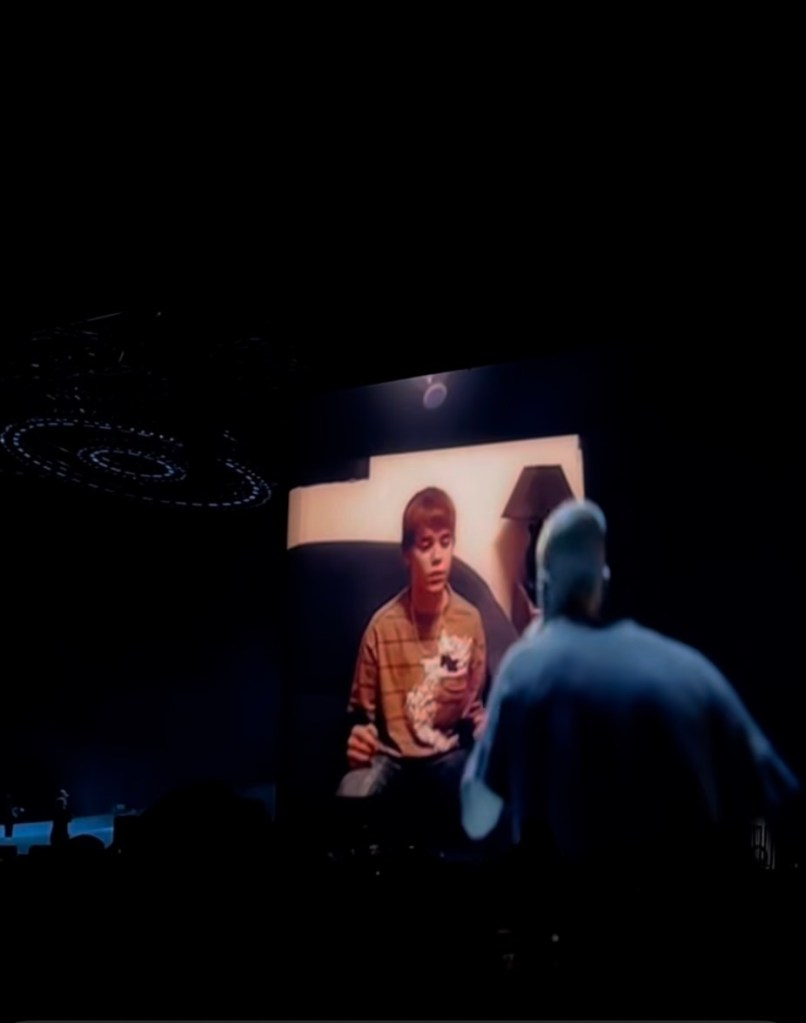
I’ve watched so much footage from his set on Saturday night at Coachella, the desert music festival that rises every year like a mirage on a wide stretch of green carved into California’s vast Coachella Valley. More than 100,000 people saw it live. And the reactions were as mixed as they were passionate about it. I found that intriguing.
I thought his set felt deeply personal, almost diaristic, as he scrolled through YouTube and dueted with his 13‑year‑old, pre‑fame self for nearly half an hour. Some of the songs were covers, filmed at home long before he became a household name.
I love that this man – who’s been giving us glimpses for years of the long, aching work of healing from what fame carved out of him as a kid – chose to reject spectacle in favour of self‑reflection in that moment. In favour of tending to that little boy.
I love that this was how he returned to the stage after so much time away. And I love that his old label didn’t make a cent from him singing the songs from the catalogue he’d sold them – because he karaoked them straight from YouTube.
I suppose this isn’t likely what most people my age have been consumed by this week. But as someone who’s trying to make her way back to her own inner child, it all resonated for me in a way I didn’t expect – watching him choose tenderness over performance, honesty over polish, presence over perfection.
I just think the world could use more of that kind of thing right now. More people willing to sit with their younger selves. More gentleness in the places where we usually demand spectacle. More courage to be seen in the unvarnished truth of who we are.
Because somewhere along the way, so many of the rest of us abandoned the softest parts of ourselves, too. We traded wonder for efficiency, curiosity for competence, play for productivity.
We learned to armour up – to be impressive instead of honest, to be useful instead of whole. And in doing so, we misplaced the small, bright creature inside us who once knew how to feel without apology, how to ask for what we needed, how to trust joy when it arrived.
Remembering the parts of you that were never meant to be negotiated away – the tenderness, the imagination, the instinct to reach for connection instead of control – is reclamation work. And when people do it, they start to move through the world differently. They soften. They stop mistaking hardness for strength. They stop passing their unhealed places on to everyone around them.
The world is starving for this right now. Not more brilliance or hustle or polish. We have an abundance of those. What we’re missing is the simple courage to be human with each other. To say: There is a younger version of me who is still hurting. And then to offer that little person care – freely and without judgment for having discovered this about yourself. When we do that, we become less reactive, maybe a little less brittle, and less afraid. We become people who can meet life with open hands instead of clenched fists.
Ultimately, the greatest and most valuable journey isn’t going to be the one that carries you across continents, or into the hands of fame. It’ll be the one that brings you home to the centre of yourself.
Sometimes by way of a mirror held up in the desert.


Leave a Reply