
Today, my phone’s photo app offered me a montage it called Looking Back. I usually ignore those compilations, but this morning I opened it as the downtown blurred past outside the train’s window, on my way to work.
There, among the images, was the photograph of my hands wrapped around my mom’s on the morning she died. I was kneeling on the floor next to her bed, my head resting on my arm – sending up silent prayers.
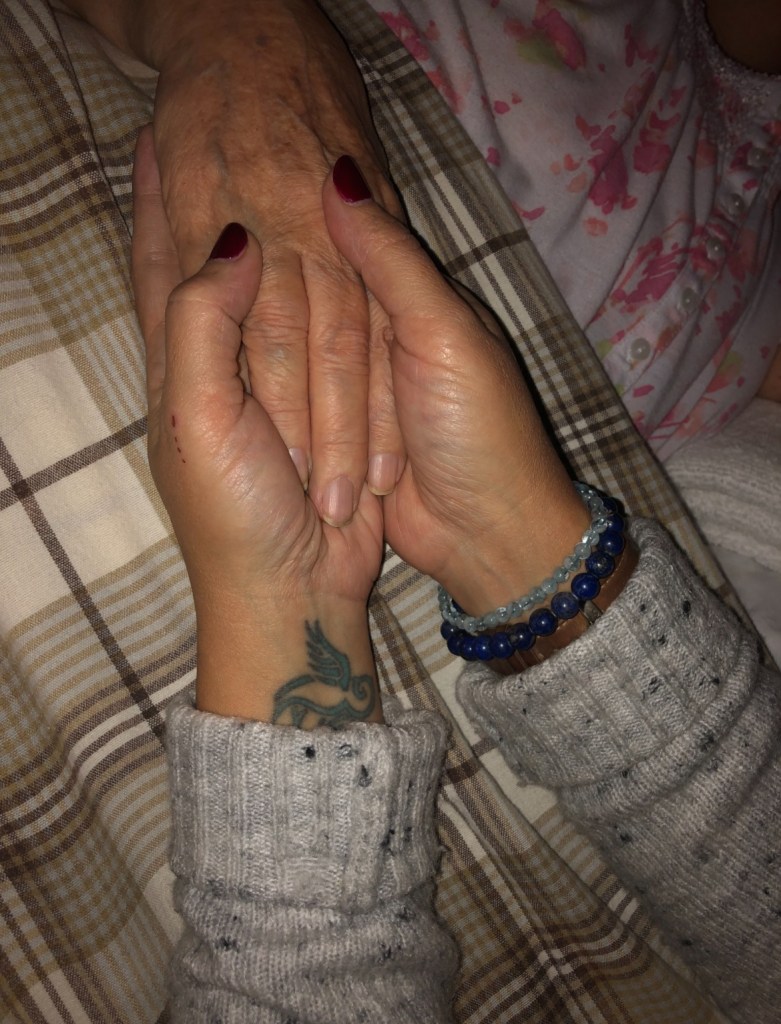
By then, my prayers had stopped being about the unbearable ache of goodbye. I was no longer praying for more time. My prayer was for her suffering to ease, for her spirit to be free.
It was a moment that I only understood, with any clarity, in hindsight: one of few moments in my life when I knew without question that letting go can be its own kind of love – even, and especially, when every part of you wants to hold on.
I know I thought about Leonard Cohen that morning: We are so lightly here, he said. He meant that our time on earth is fragile, brief – so easily swept away. Yet within that lightness lies the paradox of being human: though we are temporary, our capacity to love makes our brief stay luminous. That while our presence is fleeting, the love we give and receive endures beyond it.
I hoped then, with all my heart, for that to be true. And now I know that it is.
I looked at that photo often in the days and weeks after her death. It became a kind of tether, holding me close to the moment when love and loss converged in my hands. It was love – made visible. A fragile gesture frozen in time. The whole story of being human in one digital download. The warmth of skin against skin. The last language we spoke when words failed. The silent promise that she wouldn’t leave this world alone.
It’s been 2,192 days since I last saw her. I still wear her sweaters and socks, still sip tea from her delicate china cups. Sometimes I wear her family ring. And her bracelet – I’ve never taken it off, not once in all these nearly seven years.
These things have become so precious to me. Touchstones, infused with her presence. Reminders that love lingers – even in the ordinary things we hold – long after the person we loved has gone. Love made tangible. Grief made bearable. The personification of the human need to hold on, even as we spend a lifetime learning to let go.
But even these material bridges between worlds – between the living and the gone – can’t replace what I miss the most. While sweaters and jewelry and teacups and photographs have held me together when I’ve needed them over the years, they can’t replace the sense of home she was to me.
We are creatures of belonging. And the ache for home lives in all of us. When she died, that ache swelled until it felt like it might split me open. Since then, nothing about the concept of home has felt the same. And I know it won’t again.
For the little girl inside me, home will always be bound to the memory of her. And that child will probably always ache for what is lost – the version of the story where she still believed that home was wherever her mother was.
I’ve come to see that this particular grief is sort of a lifelong conversation between the child who cannot let go and the adult who must. The tension of the opposites. The pull between holding on and releasing. Between longing for what once was and building something new from what endures.
It seems to be within that very tension that something unexpected reveals itself: even at its sharpest edge, grief carries a kind of guidance. The ache itself becomes a compass – always pointing me back to love.


 MEANINGMAKER
Leave a reply to C Ehrat Cancel reply