
The river is rolling by this afternoon. On its way, I realize, to I don’t know where. As I sit next to it, listening to its song, I wonder why it is that such a simple thing is stirring the well of grief in me.
I’ll take a wild guess that it’s because I’m no more a master of the power and direction of my feelings than the river next to me is a master of its own speed and course. So, I sit longer and watch its eddies and currents and whorls. The way the water runs freely over shallow rocks from the basement of time. Some of them poking through the surface like the backs of ancient turtles.
A blue heron lands on the bank. A peace seeker. A sign of tranquility and patience. He always looks for a place where the land and water merge, knowing that it will be peaceful and still there. We have something in common today, I think, as I watch his long legs carry him up the river. I’m seeking the same place.
The sun is beginning to shift now, turning the river into a shimmering silver ribbon laid out across the land. Forever changing and moving.
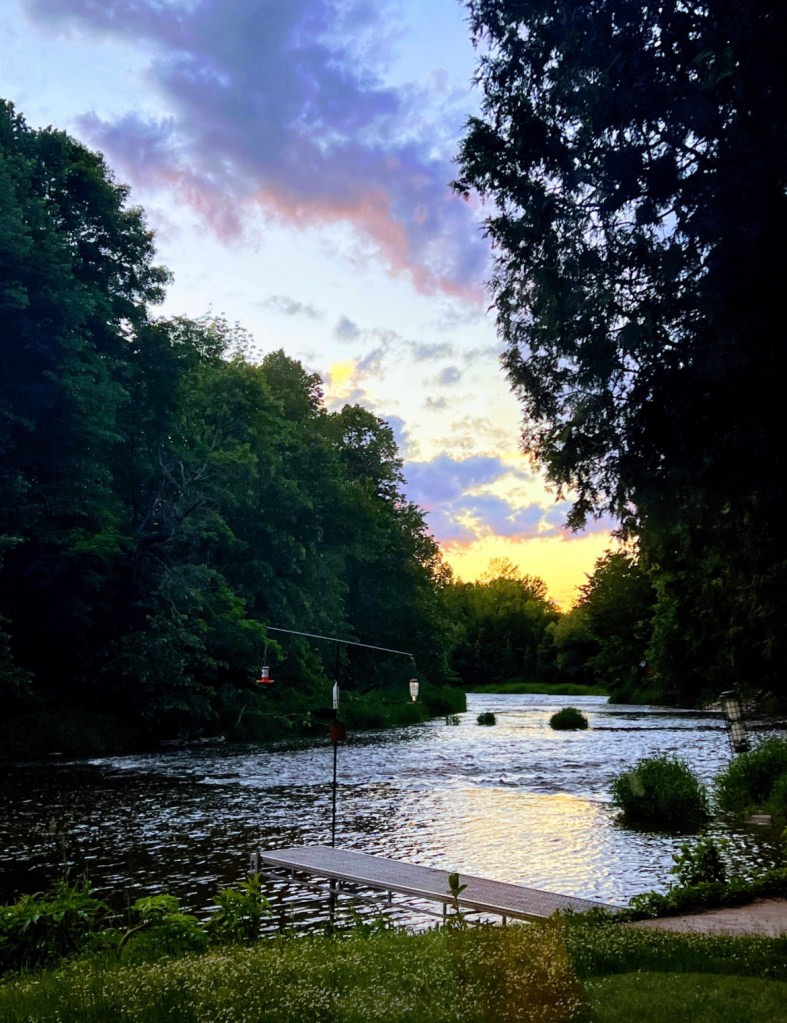
They say that rivers know the secret of time. A river will tell you that time itself doesn’t exist except for humankind’s obsession with the hours and the sorrow we so often make of lost time.
All that exists for the river is the present moment. Because rivers are everywhere, all at once. Present at their source and at their mouth. At the waterfall, the rapids, and in the current. There is no past and no future for a river.
The water that flows by me this second is the last I’ll ever see of that water and the first of the new water that will flow past me in the next second. “The last of that which has passed and the first of that which is coming,” Leonardo da Vinci once observed of the way river water moved next to him.
Rivers only know how to keep flowing. They’re never the same and they’re never still. As a seagull dives just feet from me, I think to myself that people are like that too. I’m like that. Always different, always changing.
At dinner with a friend the other night, we stepped into the churning waters and talked about our mothers dying. About how things changed after that. How we changed. About what it’s like to watch the physical life leave your mother. Slow at first, like a pinhole in a balloon. And then so fast that all of the air in the room leaves with her final exhale. How unimaginable it was to wake up in the world in those first weeks without her. Like waking up in a world without a sky.
We talked about how so much about dealing with the disease was about waiting. Waiting for appointments, for tests, for “procedures” and, of course, more broadly for “it.” For the thing itself. For the other shoe to drop.
Still, when it did start to happen, I was stunned by how quickly after stopping treatment my mother’s body was taken to pieces. How surreal the disintegration of a body with cancer can be. Yet even that didn’t prepare me for the loss of her. Even knowing that she would die didn’t prepare me. I wasn’t prepared to mourn the physical loss of her, and I didn’t know then that I’d also have to mourn the person I got to be when she was alive.
Being with my dying mom was a way of honouring the fact — so basic and obvious and yet so incomprehensible — that she would soon be gone. And with her would go my experience of being her child in the way that I had always known. The memory of that, the truth of that, came floating down the river with the current today.
In the middle of the fourth year without her, I still miss her with a quiet desperation a lot of days. And, truth be told, there is comfort in knowing that I probably always will. Because I lose her a lot still. In my dreams. Every time I see her emerald ring sitting on my dresser. When I’m picking wedding shower decorations which I know she would so loved to have done. When I unexpectedly find her slippers under the bed. Last week I found the sweater she wore to that last Christmas dinner in the back of my closet and I felt the air go out of the room again.
Grief is a universal human condition. It happens with every loss. But each person’s transactions with it seem to be exquisitely personal. It’s like you’re confronting an energy designed to break down your ability to control your own emotional landscape and the circumstances in your life.
It sometimes sweeps you along gently for awhile. But the rapids come out of nowhere. The river and grief have their own pull — what feels like their own gravitational force. I’ve always thought of grief’s force as something that pulls me down. But today, I think maybe grief is actually more like this little part of the river in front of me that gurgles with pleasure. This force seems to be designed, instead, to pull me within.
Not down. Within.
Maybe I’m learning a little something about how the river feels as its widening and deepening. Eddying back on itself. Bursting its banks when there’s too much water — too much life. Or, in my case, too much death. When parts of it dry up and the stoney remains are laid bare.
I watched her go. Her last exhale marking the fork in the river that carried her off in a direction she could only go alone. She was here, my portal into the world, flowing around me every day of my life for 48 years. And then she was not.
But like a river is a magic thing — a magic, ever-moving, living part of the very earth itself — she still lives in me in this same way. I still feel her powerfully within me on many days. She’s a part of me in ways that go beyond personality and character. Part of the current that runs below my regular, daily self.
I believe that the people we love most on this earth, and beyond, become a physical part of us. Ingrained in our synapses, in the pathways where memories are created. And I believe that there’s a reason that we don’t step in the same river twice. It’s not just that it’s never the same river — the same water. It’s that we don’t remain the same people.
The river says that everything is always on its way to somewhere else. All we can do is plunge in and let it flow.


 MEANINGMAKER
Leave a comment